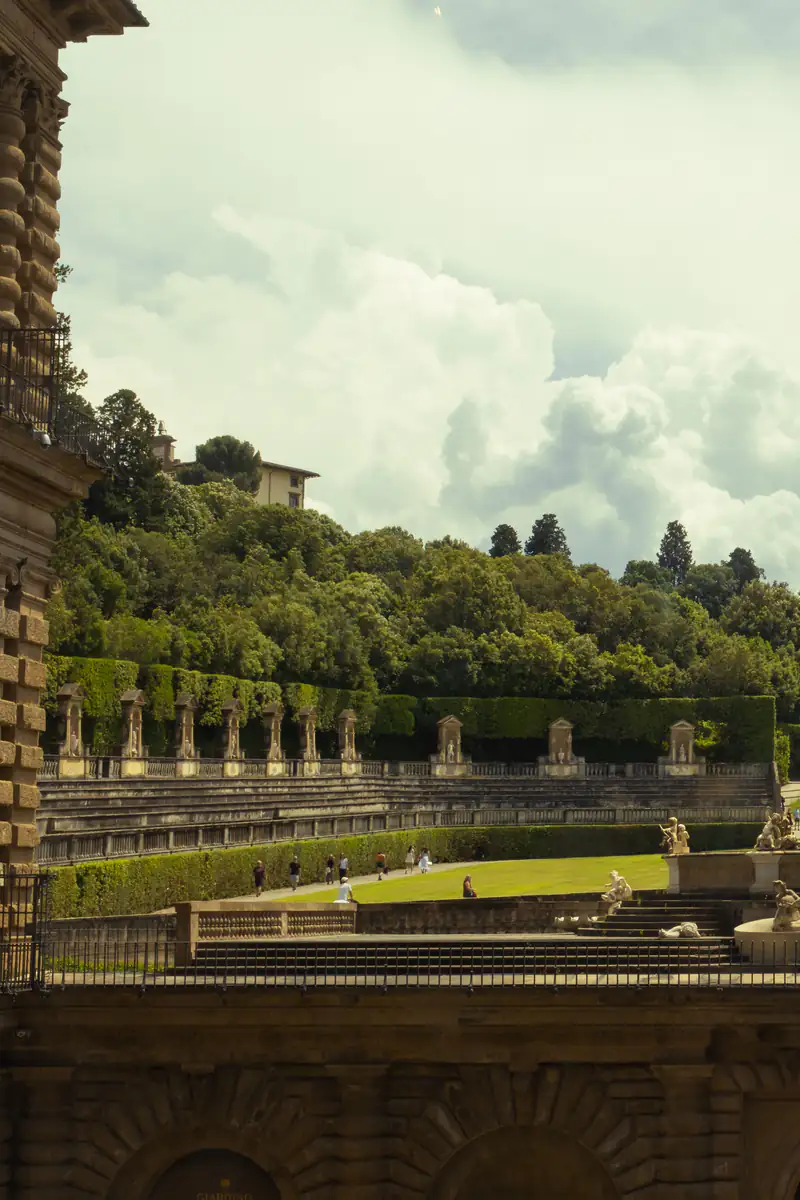
Walk the Medici's garden of statues and fountains
The Boboli Gardens — Il Giardino di Boboli — climb the hillside directly behind Palazzo Pitti in Florence, an open-air masterpiece of Italian garden design begun in the mid-16th century for the Medici.
Book the guided Boboli tour- 1549 Laid out for Eleonora di Toledo
- 11 ha Hilltop garden behind Palazzo Pitti
- UNESCO 2013 Medici Villas & Gardens in Tuscany
- 13th C. BCE Genuine Ramesses II Egyptian obelisk
Tickets and tours for Boboli Gardens
Compare the best-rated ways to visit, check live availability and book in a few taps.
- Top pick
Florence: Pitti Palace, Boboli Garden, Palatine Gallery Tour
A 3-hour tour with a licensed guide and timed entry to the Boboli Gardens, Pitti Palace and the Palatine Gallery.
From US$93Check availability ↗ Florence: Pitti Palace and Boboli Gardens Ticket & eBook
A self-guided combo ticket for the Boboli Gardens and the Pitti Palace museums, with multilingual eBooks; this ticket is non-refundable.
From US$40Check availability ↗Florence: Pitti Palace and Boboli Gardens Walking Tour
A 1.5-hour guided visit with entry tickets to both the Pitti Palace and the Boboli Gardens included.
From US$113Check availability ↗Florence: Boboli The Medici Gardens & Hidden Messages
A garden-only walk with an official local guide and Boboli entry included, focused on the Medici symbolism hidden in the gardens.
From US$88Check availability ↗
More things to do nearby
About Boboli Gardens
The Boboli Gardens — Il Giardino di Boboli — climb the hillside directly behind Palazzo Pitti in Florence, an open-air masterpiece of Italian garden design begun in the mid-16th century for the Medici. When Cosimo I de' Medici and his wife Eleonora di Toledo bought the Pitti palace in 1549, they commissioned the sculptor and garden architect Niccolò Tribolo to lay out a vast formal garden on the slope above it. Tribolo died in 1550 and the work passed through a roll-call of the era's greatest designers — Bartolomeo Ammannati, Giorgio Vasari, and above all Bernardo Buontalenti — who shaped the garden over the following decades into one of the first and most influential Italian gardens, the model that the great European gardens of Versailles and beyond would later draw on.
What you walk through today covers roughly eleven hectares of terraces, gravel avenues, clipped hedges, grottoes, and more than a hundred statues spanning antiquity to the 17th century. The Amphitheatre, carved into the hillside behind the palace, centres on a genuine ancient Egyptian obelisk of the pharaoh Ramesses II — over three thousand years old, raised in Heliopolis, carried to Rome by the emperor Domitian, acquired by the Medici, and finally set here in 1790. Below it the Neptune Fountain by Stoldo Lorenzi (1565–1568) presides over its basin; the long Viottolone avenue of cypresses descends to the Isolotto, an oval island in a pond crowned by the Oceanus Fountain. The Buontalenti Grotto near the entrance is the garden's strangest jewel — a fantastical artificial cave of dripping stone, frescoes, and sculpture.
The Boboli Gardens are one of just two gardens inscribed by UNESCO in 2013 as part of 'Medici Villas and Gardens in Tuscany' — a serial World Heritage Site of twelve villas and two gardens recognised for how the Medici created a new relationship between architecture, garden, and landscape during the Renaissance. (Boboli also stands within the Historic Centre of Florence, a separate World Heritage Site inscribed in 1982.) Originally the garden was strictly private, reserved for the Medici court; it opened to the public only in the 18th century, and today it is run by Le Gallerie degli Uffizi, the Italian state museum that also manages the Uffizi and Palazzo Pitti.
Since 13 October 2025 every ticket sold by Le Gallerie degli Uffizi — including the Boboli Gardens — is nominative: issued in the holder's name and checked against a physical identity document at the entrance. That is precisely the problem we exist to solve.
Practical information
- Opening hours
- Open daily 08:15, with the closing time set by season — earlier in winter (around 16:30) and later in high summer (up to 18:30 or 19:30). Last admission is roughly one hour before closing. The Boboli Gardens are closed on the first and last Monday of each month, and on 1 January and 25 December. Hours change through the year and can adjust for major Italian public holidays — confirm on the day, especially if travelling in deep winter or around New Year, Easter, or Ferragosto (15 August).
- Entrance
- The main entrance is through the courtyard of Palazzo Pitti, Piazza de' Pitti, on the Oltrarno (south) side of the river. There are secondary entrances at the Annalena gate (Via Romana) and the Forte di Belvedere gate. Reserved-entry ticket holders use the dedicated priority line; bring the physical ID matching the name on your ticket.
- Address
- Giardino di Boboli, Piazza de' Pitti 1, 50125 Firenze FI, Italy.
- Getting there
- From Firenze Santa Maria Novella railway station it is about a 20-minute walk through the historic centre and across the Ponte Vecchio to Palazzo Pitti. The whole area is pedestrian-friendly and inside Florence's ZTL (limited-traffic zone) — there is no driving access. City buses C3 and D serve the Pitti area from the centre.
- Accessibility
- The garden is a steep historic hillside of gravel paths, slopes, and steps, and large parts are not wheelchair-accessible; an accessible route covers the lower terraces near the palace. Visitors with a disability and one companion enter free of charge with the relevant documentation. Contact Le Gallerie degli Uffizi in advance for specific accessibility support and to confirm the accessible route currently open.
- Bag policy
- Large bags, backpacks, and bulky items should be left in the cloakroom at Palazzo Pitti. Small bags are allowed inside the garden.
- Photography
- Personal photography without flash or tripods is permitted throughout the open-air garden. Some interiors (the Porcelain Museum, the Grotto chambers) may carry their own photography rules — signage indicates where.
Plan your visit
Practical guides written by our travel team
The Best Time to Visit the Boboli Gardens
A month-by-month guide to crowds, timed-entry slots, the quiet early hours, the seasonal closing times, and the summer heat that shapes every visit to Florence's Medici garden.
Boboli Gardens Nominative Tickets — What the Name Rule Means
Since 13 October 2025 every ticket for the Boboli Gardens is issued in the visitor's name and checked against a physical ID at the gate — here is exactly what that means for booking.
How to Get to the Boboli Gardens in Florence
Walking routes from the Ponte Vecchio and the Uffizi, the nearest bus lines, and how to reach the Palazzo Pitti entrance from Florence's train stations and airport.
Frequently asked
What's the difference between the two tickets you sell?
The Boboli Gardens ticket covers the garden itself (plus the Porcelain Museum inside the grounds). The combined Pitti Palace + Boboli Gardens ticket adds the interior of Palazzo Pitti — the Palatine Gallery, the Royal Apartments, the Treasury of the Grand Dukes, and the modern-art and costume collections — and the Bardini Garden, all on one nominative reservation. If you want only a relaxed couple of hours outdoors among the fountains and statues, the Boboli ticket is enough; if you also want the Medici palace interiors, the combined ticket saves you a second visit.
When should I arrive?
Aim to be at the reserved-entry line 10–15 minutes before your booked slot, with the physical ID matching each name on the ticket ready to show. The main entrance is through the courtyard of Palazzo Pitti on Piazza de' Pitti. Arriving earlier is fine, but you will not be admitted before your window opens. There are cafés around Piazza de' Pitti to wait in nearby.
How long does a visit take?
Most visitors spend 1.5 to 2.5 hours in the garden. It is large and hilly, and rewards an unhurried wander — the climb to the Forte di Belvedere viewpoint and the walk down the Viottolone to the Isolotto each add time. A focused loop taking in the Amphitheatre, the Grotto, and the Neptune Fountain can be done in about an hour. There is no time limit once you are inside.
Which days and hours is Boboli open?
The Boboli Gardens open daily at 08:15, with the closing time varying by season — earlier in winter (around 16:30) and later in high summer (up to 18:30 or 19:30), with last admission about an hour before closing. The garden is closed on the first and last Monday of each month, and on 1 January and 25 December. Hours shift through the year, so confirm on the day if your visit falls in deep winter or around a major Italian holiday.
Are the Boboli Gardens a UNESCO World Heritage Site?
Yes — and specifically so. The Boboli Gardens are one of only two gardens inscribed in 2013 as part of 'Medici Villas and Gardens in Tuscany', a serial UNESCO World Heritage Site of twelve villas and two gardens. Boboli also stands within the Historic Centre of Florence, a separate World Heritage Site inscribed in 1982. So the garden is doubly protected — named in its own right in the 2013 listing, and inside the wider Florence inscription as well.
What is the Boboli Gardens and why is it famous?
The Boboli Gardens are a monumental 16th-century Italian garden on the hillside behind Palazzo Pitti in Florence, created for the Medici from 1549 by Niccolò Tribolo, Bartolomeo Ammannati, and Bernardo Buontalenti. Covering about eleven hectares, it is one of the first and most influential formal Italian gardens, filled with fountains, grottoes, terraces, and more than a hundred statues. Its highlights include the hillside Amphitheatre with a genuine ancient Egyptian obelisk of Ramesses II, the Neptune Fountain, the fantastical Buontalenti Grotto, and the Isolotto island with its Oceanus Fountain.
How do I get to the Boboli Gardens?
The Boboli Gardens are entered through the courtyard of Palazzo Pitti at Piazza de' Pitti 1, on the Oltrarno (south) bank of the Arno. From Firenze Santa Maria Novella railway station it is about a 20-minute walk through the historic centre and across the Ponte Vecchio; the area is inside Florence's limited-traffic zone (ZTL), so there is no car access — most visitors arrive on foot. City buses C3 and D serve the Pitti area. Florence Santa Maria Novella has direct high-speed rail to Rome, Milan, Bologna, and Venice.
How does booking work on this site?
This site is an independent visitor guide to Boboli Gardens. When you choose a ticket or tour, you book it directly with GetYourGuide, which takes the payment, issues the ticket and handles any changes or cancellations. We may earn a commission when you book, at no extra cost to you.