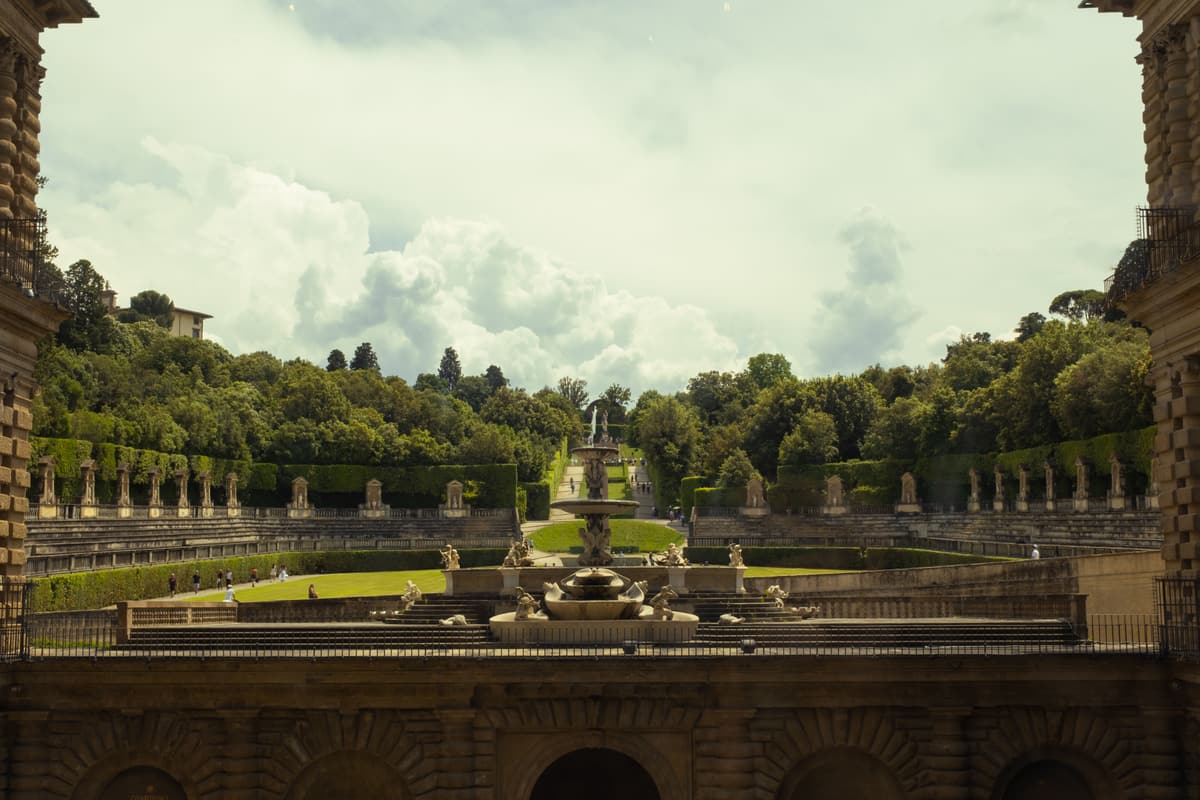
The Boboli Gardens — Il Giardino di Boboli — climb the hillside directly behind Palazzo Pitti in Florence, an open-air masterpiece of Italian garden design begun in the mid-16th century for the Medici. When Cosimo I de' Medici and his wife Eleonora di Toledo bought the Pitti palace in 1549, they commissioned the sculptor and garden architect Niccolò Tribolo to lay out a vast formal garden on the slope above it. Tribolo died in 1550 and the work passed through a roll-call of the era's greatest designers — Bartolomeo Ammannati, Giorgio Vasari, and above all Bernardo Buontalenti — who shaped the garden over the following decades into one of the first and most influential Italian gardens, the model that the great European gardens of Versailles and beyond would later draw on.
What you walk through today covers roughly eleven hectares of terraces, gravel avenues, clipped hedges, grottoes, and more than a hundred statues spanning antiquity to the 17th century. The Amphitheatre, carved into the hillside behind the palace, centres on a genuine ancient Egyptian obelisk of the pharaoh Ramesses II — over three thousand years old, raised in Heliopolis, carried to Rome by the emperor Domitian, acquired by the Medici, and finally set here in 1790. Below it the Neptune Fountain by Stoldo Lorenzi (1565–1568) presides over its basin; the long Viottolone avenue of cypresses descends to the Isolotto, an oval island in a pond crowned by the Oceanus Fountain. The Buontalenti Grotto near the entrance is the garden's strangest jewel — a fantastical artificial cave of dripping stone, frescoes, and sculpture.
The Boboli Gardens are one of just two gardens inscribed by UNESCO in 2013 as part of 'Medici Villas and Gardens in Tuscany' — a serial World Heritage Site of twelve villas and two gardens recognised for how the Medici created a new relationship between architecture, garden, and landscape during the Renaissance. (Boboli also stands within the Historic Centre of Florence, a separate World Heritage Site inscribed in 1982.) Originally the garden was strictly private, reserved for the Medici court; it opened to the public only in the 18th century, and today it is run by Le Gallerie degli Uffizi, the Italian state museum that also manages the Uffizi and Palazzo Pitti.
Since 13 October 2025 every ticket sold by Le Gallerie degli Uffizi — including the Boboli Gardens — is nominative: issued in the holder's name and checked against a physical identity document at the entrance. This is the single most important fact for any visitor booking in advance: the name on the ticket must exactly match the passport or ID you travel on, and there is no entry and no refund if it does not. That is precisely the problem we exist to solve. When you book through us, we collect each visitor's exact name and enter it correctly with the operator, hold your reserved timed-entry slot, and deliver an ID-matched ticket ready to scan — so the gate is a formality, not a risk.