 Skip-the-line available
 A History of the Boboli Gardens
From Eleonora di Toledo's mid-16th-century commission to the Medici, Habsburg-Lorraine and Savoy eras — how Florence's great Renaissance garden took shape behind Palazzo Pitti.
The Boboli Gardens were laid out from the mid-sixteenth century for Eleonora di Toledo, wife of Cosimo I de' Medici, as the private garden of the newly acquired Palazzo Pitti in Florence. Conceived as a showcase of Medici power, the garden grew over generations into one of the first and most influential formal gardens in Europe, a model that shaped courtly garden design across the continent. Successive architects — Niccolò Tribolo, Bartolomeo Ammannati, Bernardo Buontalenti and later Giulio Parigi — shaped its axes, grottoes and sculpture, and it was extended through the seventeenth century to its present size. This guide traces the garden's history from the Medici through the Habsburg-Lorraine and Savoy eras to its status today as an open-air museum within Florence's UNESCO-listed historic centre.
When were the Boboli Gardens created and by whom?
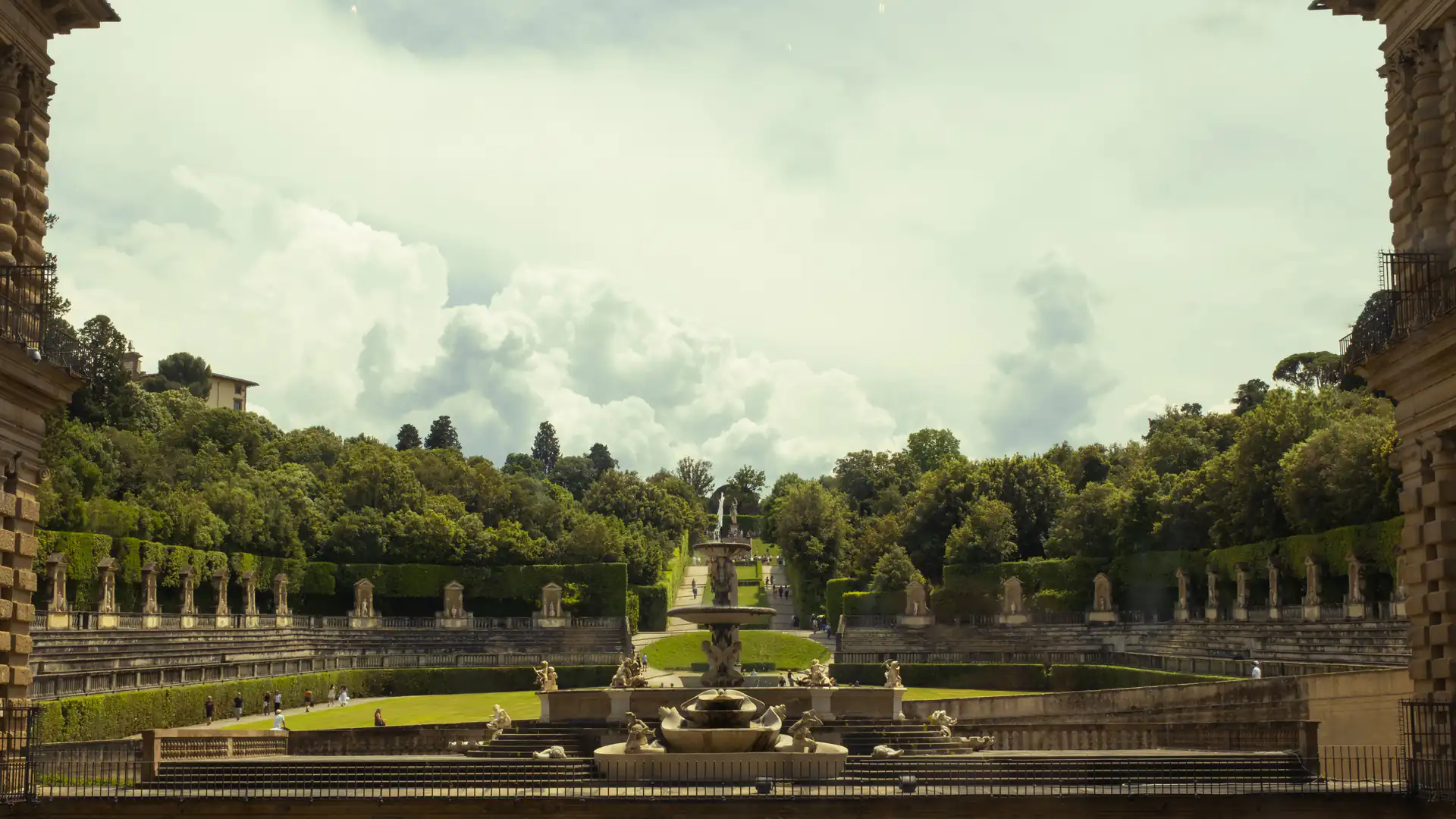
The Boboli Gardens were laid out from the mid-sixteenth century for Eleonora di Toledo, wife of Cosimo I de' Medici, Duke of Florence, as the garden of the Medici family's Palazzo Pitti. The Medici had acquired the palace and the land on the Boboli hill behind it to create a grand formal park fitting their rising power. Work began under the sculptor and garden designer Niccolò Tribolo, who set out the initial scheme before his death in 1550; Bartolomeo Ammannati then continued the construction, with Giorgio Vasari also contributing to the planning. The Amphitheatre carved into the slope directly behind the palace became the garden's ceremonial heart, a stage for Medici court spectacles. From the outset the Boboli Gardens were designed not as a private retreat alone but as a public statement of Medici magnificence in Florence.
The early Boboli Gardens established the formal, sculptural character that still defines them. Bernardo Buontalenti designed the celebrated three-chambered grotto near the entrance and much of the garden's statuary, blending architecture, art and fantastical rockwork in the Mannerist taste of the late sixteenth century. The central axis climbing from the palace through the Amphitheatre to the upper terraces gave the garden its monumental perspective, punctuated by fountains such as the Neptune fountain created by Stoldo Lorenzi between 1565 and 1568. Ancient works, including an Egyptian obelisk later placed in the Amphitheatre, and Roman antiquities were set among the plantings, so the garden functioned from early on as an open-air museum. This first phase made the Boboli Gardens a prototype of the Italian Renaissance garden, widely imitated by European courts in the century that followed.
How did the Boboli Gardens grow under the Medici?
Under successive generations of the Medici the Boboli Gardens expanded well beyond their original core behind Palazzo Pitti. The most significant enlargement came in the early seventeenth century, when Giulio Parigi laid out the Viottolone around 1618 — a long, straight avenue of cypresses driving diagonally down the hillside to a new lower garden. At its foot Parigi and his successors created the Isolotto, an oval island in an ornamental basin centred on the Fountain of the Ocean, ringed with citrus trees and statues. This second axis roughly doubled the garden's reach and gave it the two-directional plan visitors still follow today. The seventeenth-century Medici also enriched the garden with further fountains, statues and architectural set-pieces, cementing its role as both a pleasure ground and a dynastic showcase for a family that ruled Florence and Tuscany.
The Medici used the Boboli Gardens as a theatre of power as much as a garden. The Amphitheatre behind Palazzo Pitti staged lavish court festivities, weddings and musical spectacles, its terraced seating designed for an audience watching performances on the lawn below — a tradition credited with helping shape the early history of opera and courtly entertainment in Florence. The grottoes, the water features and the carefully framed views were all part of a deliberate programme to impress visitors and ambassadors with Medici sophistication and wealth. By the time the main Medici line ended in the early eighteenth century, the Boboli Gardens had become one of the grandest and most influential gardens in Europe, its formal layout, sculpture and grottoes copied at princely courts far beyond Tuscany, including at the great royal gardens of France.
Who owned the Boboli Gardens after the Medici?
When the main Medici line died out in 1737, Palazzo Pitti and the Boboli Gardens passed, with the rest of the Grand Duchy of Tuscany, to the House of Habsburg-Lorraine. The new Lorraine grand dukes maintained and adapted the garden in the taste of the eighteenth century, and it was in this period that the green-and-white Kaffeehaus pavilion was built on the upper slope as a place to take coffee and enjoy the view over Florence — a fashionable Rococo addition to the older Medici framework. The Lorraine rulers also kept the garden's role as a semi-public amenity of the palace, preserving its avenues, fountains and sculpture largely as the Medici had left them while adding refinements of their own. The essential Renaissance structure survived these changes intact. The Lorraine period thus layered eighteenth-century refinement onto the Medici framework without disturbing the garden's Renaissance bones on the hillside behind Palazzo Pitti.
In the nineteenth century Palazzo Pitti and the Boboli Gardens served briefly as a royal residence of the House of Savoy, when Florence was the capital of the newly unified Kingdom of Italy from 1865 to 1871. After Italy's unification the palace and garden eventually passed to the Italian state, which opened them fully to the public and manages them today as part of Florence's museum heritage. Through all these changes of ownership — Medici, Habsburg-Lorraine and Savoy — the Boboli Gardens kept the shape given to them by their Renaissance and early-Baroque designers, and the great majority of what a visitor sees now, from the Amphitheatre and grotto to the Viottolone and Isolotto, dates from the Medici and Lorraine eras rather than from later remaking. This continuity across three ruling houses is precisely why the garden survives today as such a complete document of its own long history.
Why are the Boboli Gardens historically important?
The Boboli Gardens are historically important as one of the earliest and most influential examples of the Italian Renaissance formal garden, a model that spread across Europe. Their combination of a strong architectural axis rising from the palace, terraced levels exploiting the hillside, monumental fountains, theatrical grottoes and an integrated collection of antique and contemporary sculpture set a template that princely and royal gardens imitated for generations, from Italy to France and beyond. Created for the Medici, the family whose patronage helped drive the Florentine Renaissance, the garden is inseparable from the wider cultural flowering of sixteenth-century Florence. It survives remarkably complete, so it reads today less as a ruin than as a living document of how a great Renaissance court shaped nature into art on a monumental scale behind Palazzo Pitti. Standing in the Amphitheatre behind Palazzo Pitti, a visitor is looking at one of the founding models of the European formal garden, laid out on a single Florentine hillside.
The Boboli Gardens also carry international heritage recognition as part of the Historic Centre of Florence, inscribed on the UNESCO World Heritage List in 1982 for its outstanding contribution to Renaissance art and architecture. Within that listing the garden functions as an open-air museum, home to Roman antiquities and sixteenth- and seventeenth-century sculpture displayed in the landscape rather than a gallery. Its association with Medici court spectacle, and in particular the Amphitheatre's role in the early history of staged musical performance, adds a further layer of cultural significance. For visitors this means the Boboli Gardens are not simply a pleasant place to walk but a genuine monument — the setting where Renaissance Florence expressed its wealth, learning and artistic ambition through the deliberate shaping of a whole hillside. In this sense the garden is a monument to Renaissance Florence itself, expressed through the deliberate shaping of terrain, water and stone rather than through any single building.
What survives of the original Boboli Gardens today?
A great deal of the original Boboli Gardens survives, which is part of what makes the site so remarkable. The Amphitheatre carved into the slope behind Palazzo Pitti remains the ceremonial heart of the garden, now crowned by the ancient Egyptian obelisk and a large granite basin added in later centuries. The Buontalenti Grotto near the entrance still displays its Mannerist rockwork and its sculpture, including copies of Michelangelo's Prisoners in the first chamber. The Neptune fountain by Stoldo Lorenzi still presides over its pool, and the Viottolone cypress avenue laid out around 1618 still descends to the Isolotto and its Fountain of the Ocean. Together these features let a visitor read the garden's Medici and early-Baroque design almost as its makers intended, across around 45,000 square metres of hillside. Walking the central axis from the grotto up to the terraces is, in effect, walking the garden as its sixteenth-century Medici designers first conceived it.
Later additions sit comfortably within this Renaissance framework rather than overwriting it. The eighteenth-century Kaffeehaus pavilion, built in the Lorraine era, brought a lighter Rococo note to the upper terraces, and the Porcelain Museum was installed in the Casino del Cavaliere at the top of the garden in the twentieth century, opening in 1973 to display Medici and later ceramics. The Roman antique statues and Renaissance sculptures scattered through the parterres and along the avenues continue the garden's original role as an open-air museum. The concierge point for anyone interested in the history is that a walk through the Boboli Gardens is effectively a walk through several centuries of Florentine taste at once — Medici, Lorraine and modern conservation layered on a single hillside behind one of the city's greatest palaces. Each layer sits legibly on the hillside, so the Boboli Gardens repay a visitor who reads them as a record of changing Florentine taste over four centuries.
Frequently asked
When were the Boboli Gardens created?
From the mid-16th century, for Eleonora di Toledo, wife of Cosimo I de' Medici, as the garden of Palazzo Pitti. Work began under Niccolò Tribolo before his death in 1550 and continued under Bartolomeo Ammannati.
Who built the Boboli Gardens?
They were commissioned by the Medici and shaped by several architects: Niccolò Tribolo, then Bartolomeo Ammannati, with Bernardo Buontalenti designing the grotto and sculpture, and Giulio Parigi laying out the Viottolone cypress avenue around 1618.
Why did the Medici build the Boboli Gardens?
As a private garden and a public statement of Medici power behind their new Palazzo Pitti. The Amphitheatre staged lavish court spectacles, and the whole garden was designed to display the family's wealth, taste and cultural ambition in Florence.
How did the Boboli Gardens expand?
The main enlargement came in the early 17th century, when Giulio Parigi laid out the Viottolone cypress avenue around 1618 down to the new Isolotto and its Fountain of the Ocean, roughly doubling the garden and giving it its two-axis plan.
Who owned the Boboli Gardens after the Medici?
When the Medici line ended in 1737, the garden passed with Tuscany to the House of Habsburg-Lorraine, who added the Kaffeehaus pavilion, and briefly to the House of Savoy in the 1860s before passing to the Italian state.
Are the Boboli Gardens a UNESCO World Heritage Site?
Yes. They form part of the Historic Centre of Florence, inscribed on the UNESCO World Heritage List in 1982 for its outstanding contribution to Renaissance art and architecture. The garden functions as an open-air sculpture museum.
Why are the Boboli Gardens important?
They are one of the earliest and most influential Italian Renaissance formal gardens, a model imitated by European courts. Created for the Medici, they combine a monumental axis, fountains, grottoes and an integrated sculpture collection on one hillside.
What is the oldest part of the Boboli Gardens?
The central axis behind Palazzo Pitti, including the Amphitheatre and the mid-16th-century layout begun under Tribolo and Ammannati, and Buontalenti's grotto. This original Medici core still forms the ceremonial heart of the garden.
How big are the Boboli Gardens?
Around 45,000 square metres of hillside behind Palazzo Pitti, extended to roughly their present size during the 17th century. The scale allows the two-axis design of central terraces and the diagonal Viottolone avenue.