 Skip-the-line available
 What to See in the Boboli Gardens
The Amphitheatre and Egyptian obelisk, the Buontalenti Grotto, the Neptune and Ocean fountains, the Viottolone cypress avenue, and the panoramas over Florence — a concierge tour of the highlights.
The Boboli Gardens are an open-air museum of sculpture as much as a garden — around 45,000 square metres of hillside behind Palazzo Pitti laid out with fountains, grottoes, Roman antiquities and Renaissance statues along formal avenues. The essential sights climb from the Amphitheatre and its ancient Egyptian obelisk directly behind the palace, up past the Neptune fountain to the Kaffeehaus and the Forte di Belvedere views, then down the long Viottolone cypress avenue to the Isolotto with its Fountain of the Ocean. Near the entrance stands the celebrated Buontalenti Grotto. This guide walks the highlights in a natural order, names the key monuments and their makers, and helps you decide what to prioritise if your time is short.
What are the main sights in the Boboli Gardens?
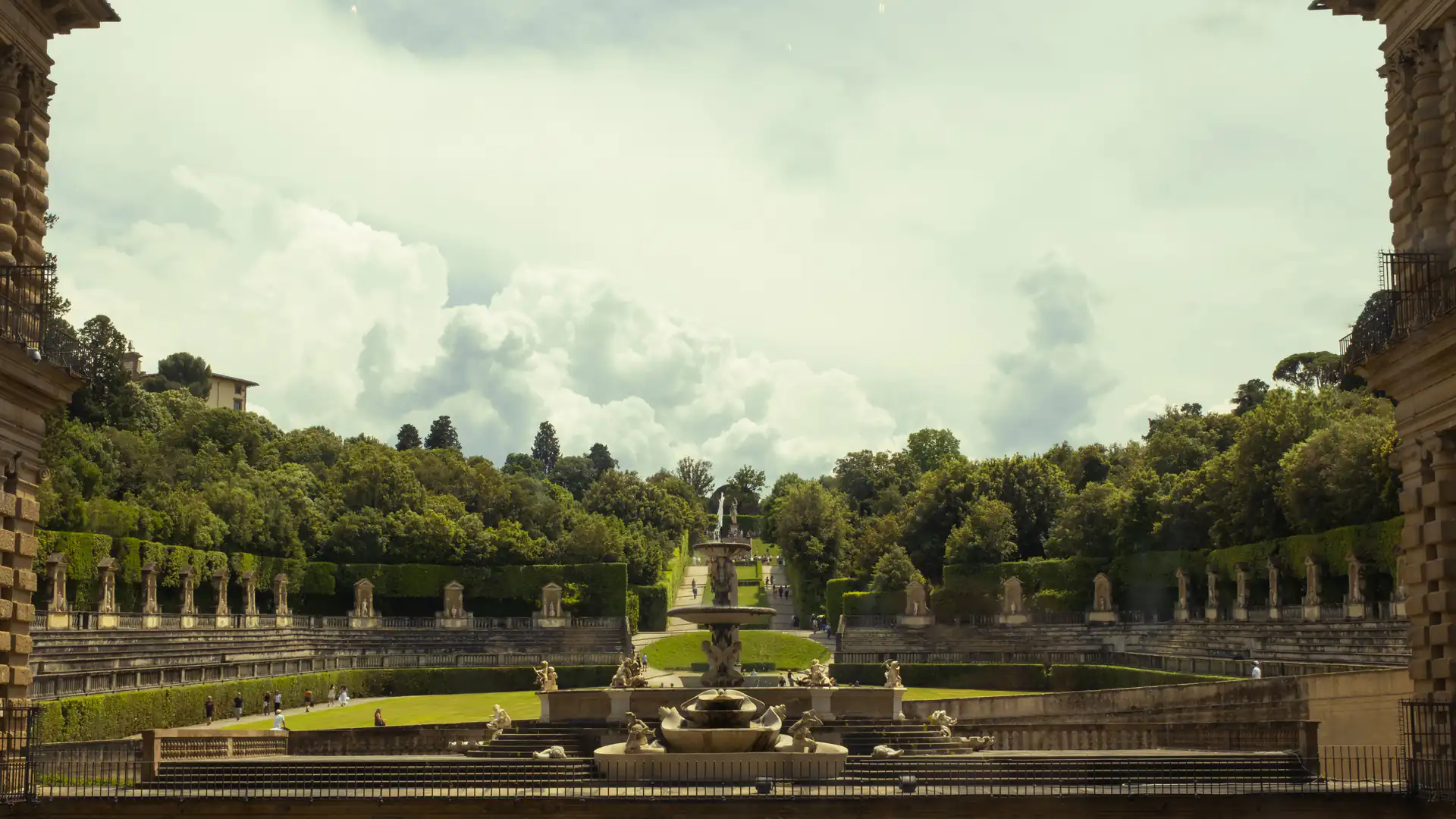
The main sights of the Boboli Gardens form a natural climbing route from Palazzo Pitti. Directly behind the palace lies the Amphitheatre, a horseshoe of terraced seating around a lawn, crowned by an ancient Egyptian obelisk brought from the Villa Medici in Rome and a large granite basin. Above it the Neptune fountain, created by Stoldo Lorenzi between 1565 and 1568 and known locally as the Fountain of the Pitchfork, presides over a pool. Higher still, the Kaffeehaus — an eighteenth-century pavilion — and the nearby ramparts of the Forte di Belvedere give the finest panoramas over the domes and towers of Florence. From the upper garden the Viottolone, a long avenue of cypresses laid out by Giulio Parigi around 1618, descends to the Isolotto. Allowing two hours lets you take in all of these without rushing the climb.
Beyond the central axis, the Boboli Gardens reward wandering. The Isolotto is an oval island set in an ornamental basin, ringed by citrus in pots and centred on the Fountain of the Ocean, with statues of Perseus and Andromeda in the surrounding water. Scattered through the box-hedged parterres and along the avenues are Roman antique statues and sixteenth- and seventeenth-century works, so the garden reads as an outdoor sculpture museum. Near the top, in the Casino del Cavaliere, the Porcelain Museum displays Medici and later ceramics and enjoys one of the best views in the garden. The concierge recommendation is to climb the central axis first while you are fresh — Amphitheatre, Neptune, Kaffeehaus, Belvedere — then let the descent down the Viottolone to the Isolotto be the relaxed, downhill second half of the visit.
What is the Buontalenti Grotto in the Boboli Gardens?
The Buontalenti Grotto, near the garden entrance behind Palazzo Pitti, is the most famous single feature of the Boboli Gardens and a masterpiece of Mannerist garden design. Designed by Bernardo Buontalenti in the later sixteenth century, it is a three-chambered artificial cave whose facade and interior blend architecture, sculpture and fantastical rockwork dripping with simulated stalactites, shells and figures. The first chamber originally held Michelangelo's unfinished Prisoners (Slaves) — now represented by copies, the originals having been moved to the Galleria dell'Accademia — set as if struggling out of the rough stone. Deeper inside stand Giambologna's Bathing Venus and a group of Paris and Helen by Vincenzo de' Rossi. The grotto was conceived as a theatrical, illusionistic space where art and nature deliberately blur, and it remains the single most atmospheric stop for many visitors to Boboli.
Access to the interior of the Buontalenti Grotto in the Boboli Gardens can be limited, and the chambers are sometimes viewable only at set times or through a grille to protect the fragile decoration, so it is worth checking arrangements on the day at the entrance. Even viewed from the mouth of the cave the facade is remarkable — an encrusted, almost living wall of stone that reads as one of the boldest statements of late-Renaissance taste in Florence. Because it sits close to the entrance behind Palazzo Pitti, it is easy to take in the grotto at the very start of a visit, before the climb up to the Neptune fountain and the terraces. The concierge tip is to look for it first, while the light at the cave mouth is good and before the mid-morning groups gather at what is one of the garden's most photographed spots.
What are the best views in the Boboli Gardens?
The best views in the Boboli Gardens come from the upper terraces, where the hillside opens over the historic centre of Florence. The area around the Forte di Belvedere, the star-shaped fortress at the garden's high south-eastern edge, gives sweeping panoramas of the domes, towers and rooftops on both banks of the Arno — Brunelleschi's cathedral dome and Giotto's campanile prominent among them. The Kaffeehaus terrace, a little lower, offers another fine outlook framed by its green-and-white eighteenth-century pavilion. These vantage points are the reward for the climb up from the Amphitheatre, and they are at their most magical in the soft light of early morning or late afternoon. Because the garden closes in the late afternoon in winter and later in summer, timing a slot for golden hour is the concierge way to catch the panorama at its best.
Looking the other way, the Boboli Gardens also frame classic views of Palazzo Pitti and Florence's own layout. From the top of the Amphitheatre the palace's vast facade fills the foreground, while the axis of the garden — Amphitheatre, Neptune fountain, and the rising terraces — draws the eye up the hillside in the deliberate perspective the Medici designers intended. The long Viottolone cypress avenue offers a different kind of view: a shaded, arrow-straight corridor of ancient trees dropping toward the Isolotto, punctuated by statues. For photographers, the combination of formal geometry, sculpture and the city beyond makes Boboli one of the most rewarding outdoor sites in Florence. The upper terraces near the Forte di Belvedere are the single best spot; arrive early or late to have them to yourself. Coming early or late not only softens the light but leaves the Forte di Belvedere edge quiet enough to take in the full sweep of the city undisturbed.
How is the Boboli Gardens laid out?
The Boboli Gardens are laid out along two main axes climbing a hillside behind Palazzo Pitti. The first and oldest axis runs straight up from the palace: through the Amphitheatre with its Egyptian obelisk, past the Neptune fountain, and on to the upper terraces near the Kaffeehaus and the Forte di Belvedere. The second axis, the Viottolone, is a long cypress-lined avenue laid out by Giulio Parigi around 1618 that cuts diagonally down the slope to the Isolotto and its Fountain of the Ocean at the garden's lower south-western end. Between and around these avenues lie box-hedged parterres, groves, and dozens of statues set as an open-air sculpture museum. Understanding the two-axis plan makes navigation simple: climb one, descend the other, and you pass nearly every major feature in a single looping walk of about two hours.
The garden's design reflects its long Medici history: begun in the mid-sixteenth century for Eleonora di Toledo, wife of Cosimo I de' Medici, and extended through the seventeenth century into the wooded, avenue-crossed park seen today. It occupies around 45,000 square metres, so it is large enough to absorb crowds yet compact enough to walk in a couple of hours. The terrain is genuinely hilly, with gravel paths and stone steps, so proper shoes matter. The concierge recommendation for a first visit is the classic loop: enter behind Palazzo Pitti, take in the Buontalenti Grotto near the gate, climb the central axis to the Belvedere views, then descend the Viottolone to the Isolotto and back — a route that captures the Boboli Gardens' scale, sculpture and panoramas in one continuous walk. Following the classic loop from the Buontalenti Grotto near the gate to the Belvedere views and down the Viottolone captures the garden's scale in one continuous walk.
What can I see with children or in a short visit?
If your time in the Boboli Gardens is short — an hour rather than two — prioritise the sights closest to the entrance and the central axis. The Buontalenti Grotto is a few steps from the gate, then the Amphitheatre with its Egyptian obelisk sits directly behind Palazzo Pitti, and the Neptune fountain is a short climb above. If you have the legs for it, push on to the Kaffeehaus terrace for the Florence panorama before turning back. This compact loop captures the garden's most celebrated features without committing to the full descent of the Viottolone to the Isolotto, which adds real time and a climb back up. The concierge tip for a quick visit is to enter at the first slot, see the grotto and Amphitheatre while they are quiet, and keep the far corners for a return trip.
The Boboli Gardens work well with children because they are, at heart, a huge open-air space to roam rather than a hushed museum. The fountains — Neptune's pool, the Ocean fountain on the Isolotto with its statues in the water — and the theatrical rockwork of the Buontalenti Grotto tend to hold young attention, and the wide lawns of the Amphitheatre give room to move. Entry to the garden is free for visitors under 18, though a named admission ticket may still need to be reserved for each child under the current system. Bear in mind the hilly, gravelly terrain and the lack of shade on the open avenues in summer heat, so bring water and sun protection. For families the relaxed downhill stretch of the Viottolone toward the Isolotto is often the most enjoyable part of the walk.
Frequently asked
What are the must-see sights in the Boboli Gardens?
The Amphitheatre and Egyptian obelisk behind Palazzo Pitti, the Buontalenti Grotto near the entrance, the Neptune fountain, the Forte di Belvedere and Kaffeehaus views over Florence, and the Isolotto with its Fountain of the Ocean at the foot of the Viottolone.
What is the Buontalenti Grotto?
A three-chambered artificial cave designed by Bernardo Buontalenti in the later 16th century, encrusted with fantastical rockwork. It held copies of Michelangelo's Prisoners, Giambologna's Bathing Venus, and a Paris and Helen group by Vincenzo de' Rossi. It sits near the entrance.
How big are the Boboli Gardens?
Around 45,000 square metres of hillside behind Palazzo Pitti. The scale means it absorbs crowds well, yet it is compact enough to walk the main loop — up the central axis and down the Viottolone — in about two hours.
What is the Isolotto in the Boboli Gardens?
An oval island set in an ornamental basin at the foot of the Viottolone cypress avenue, centred on the Fountain of the Ocean and ringed with citrus and statues of Perseus and Andromeda in the surrounding water.
Where are the best views in the Boboli Gardens?
From the upper terraces near the Forte di Belvedere and the Kaffeehaus, which give sweeping panoramas over Florence, including Brunelleschi's cathedral dome and Giotto's campanile. They are best in early-morning or late-afternoon light.
Who designed the Boboli Gardens?
Work began under Niccolò Tribolo before his death in 1550, continuing with Bartolomeo Ammannati; Bernardo Buontalenti designed the grotto and sculptures, and Giulio Parigi laid out the Viottolone cypress avenue around 1618.
How long does it take to see the Boboli Gardens?
About two hours for the main loop, taking in the Amphitheatre, Neptune fountain, Belvedere views and the Isolotto. A brisk visit of the sights near the entrance and central axis can be done in around an hour.
Is there a museum inside the Boboli Gardens?
Yes — the Porcelain Museum, in the Casino del Cavaliere at the top of the garden, displays Medici and later ceramics and enjoys one of the finest views in the grounds. Confirm its current opening arrangement on the day.
Are the Boboli Gardens good for children?
Yes. They are a large open-air space with fountains, lawns and the theatrical Buontalenti Grotto. Entry is free for under-18s, though a named ticket may still be needed. Note the hilly, gravelly terrain and lack of shade in summer.